Eclipse!!
The Great Solar Eclipse of 2017 crossed the continent, from Oregon to South Carolina, and gave millions of people the chance to witness one of the most awe-inspiring events in the natural world.

Nik's photo of the August 21 eclipse, photographed from Glendo, Wyoming. The star, Regulus, is barely visible to the lower left of the solar corona.
But you had to be within the "path of totality", a
narrow band across the earth's surface several thousand miles long but only about 70 miles wide. Outside that band you would only see a partial eclipse, not a total eclipse.
And there is no such thing as a "partial total eclipse", despite the impression blogs and the news media might give.
I honestly think that's why so many people misunderstand the utter beauty of the spectacle; they may have seen a partial eclipse in the past that was total somewhere else, and even though they weren't in the path the news kept gushing about it being a
total eclipse, so they assume they must have seen a total eclipse and just didn't find it all that impressive.
Posted by Dan 08/29/2017, revised 09/06/2017
(Our kids have grown and are no longer posting blog stories here.
Below are some highlights from past posts.)
This Seems Like a lot of Work for a Free Banana
It's been awhile since I've done an ocean swim, and I'm gearing up for
IM Santa Cruz 70.3 in September,
so Tri Santa Cruz International seemed like a good warmup.
The swim start was located just to the right of the boardwalk and the pier, and though many people had commented that the water was unusually warm and calm (relatively speaking), it was a bit of an adjustment from the comfortable pools and lakes I've been in all summer. Water temp was in the low 60s but I was immediately struck by how cold it was on my face. Eeee! How do the surfers stand it? I needed a little extra time in the water to warm up, which turned out to be fine since the race start was delayed.
This race had an interesting approach to the wave start times. There were just three waves and participants seeded themselves. Wave 1 was for those who would swim 1500 meters in under 24 minutes. Wave 2 was for 24-30 minute swimmers. And Wave 3 was for the over 30 minute swimmers. This would make for a much cleaner start with people being matched by pace, but since the course was two loops, it was still likely to get crowded on Loop #2. When I registered online, I hadn't yet achieved my 23 minute swim PR, and so I figured I was right on the cusp of Waves 1 and 2. I thought about some of my previous ocean swims, many of which didn't go so well, and decided Wave 2 would be most realistic for this race.
As we lined up on the beach, I realized that without all the sub-24 swimmers in my wave, I was likely to be in the unfamiliar position of leading the swim. On the one hand this is great since it means a clear and unobstructed path, but I've become so accustomed to following feet in the water, it was a little disconcerting to have three of the front four guys fall away within the first few minutes of the swim. Wave 1 had a five minute head start on us, so they were no longer in view, and soon there was only a single set of splashing feet a half a dozen yards ahead of me, and no one else to be seen. The course had just two turns, but for some reason, I had trouble keeping count. Alone out there in the morning grayness, I began to second guess myself. Had I turned around two buoys already or just one? Did I miss one? I couldn't remember. Meanwhile the gently rocking ocean water and the aggressively salty flavor in my mouth were starting to make me feel just slightly nauseous. After what seemed like an eternity, I emerged on the beach to run around the beach buoy and return to the water for Lap #2. I glanced at my watch as I ran, and between blurry droplets, I made out what appeared to say 16:30. WHAT?! I was certain I had held a good line out there. And I was certain no one had passed me. Somehow I was headed for a 30+ swim, yet I was at the front of my 24-30 wave? None of us would even come close to the 30 minute mark, I was leading our entire wave to failure! I tried, but couldn't persuade myself to believe that perhaps the second lap would somehow be shorter than the first, so I resolved the issue by convincing myself that I must have just read my watch wrong. But sure enough, when I emerged from Lap #2 and headed toward transition, my watch definitely said 33 minutes. Argh! Why do I suck so bad at ocean swimming?!
(Post race I found out that the reason for the horrendously slow swim times was a mismeasure of the course. The race officials later claimed it was 1800 meters instead of 1500, but I also heard rumors it ended up being 1.3 miles, which is nearly 2100 meters! Oops)
Well, fortunately the swim was over and I had nowhere to go but up, starting with the long run to transition. I had stashed a pair of shoes (legit running shoes, with speed laces, none of this flip flop business for me) near the beach and leveraged my run speed on that T1 run to pass a lot of Wave 1 folks.
Posted by Kimberly 09/01/2015
Bankok :-(
Chiang Mai :-|
Pai :-)
Chiang Mai:
Chiang Mai was fun. We stayed for four days. It is much better than Bangkok.
Pai:
We travelled to Pai on the recommendation of fellow travellers, hearing only good things from people who we had reason to trust. We were not disappointed. Pai is a small town nestled in the northern hills of Thailand, very close to the borders of Burma and Laos.

The hills around Pai
Posted by nik 10/31/2008, revised 11/05/2008
Snippets of Life - Part 4: La vida hermosa
March low tides - another fantastic week of field work! This time around, we went to some of the experiment sites that I had not yet been to... which were located on some of the most beautiful beaches of Ecuador! Once again, I feel so fortunate to be in the field of work that I'm in. At the experimental sites, I would look up from my work and glance around at the blue water, long stretches of fine sand, curling waves, and puffy white clouds, and I would have to take a brief moment to breathe it all in and smile.
One of the beaches I got to enjoy, Playita, is actually closed to the public, as it is a very important and fragile breeding ground for sea turtles. But with a piece of paper that grants permission to conduct scientific research in that location, we get to enjoy a pristine beach all to ourselves!
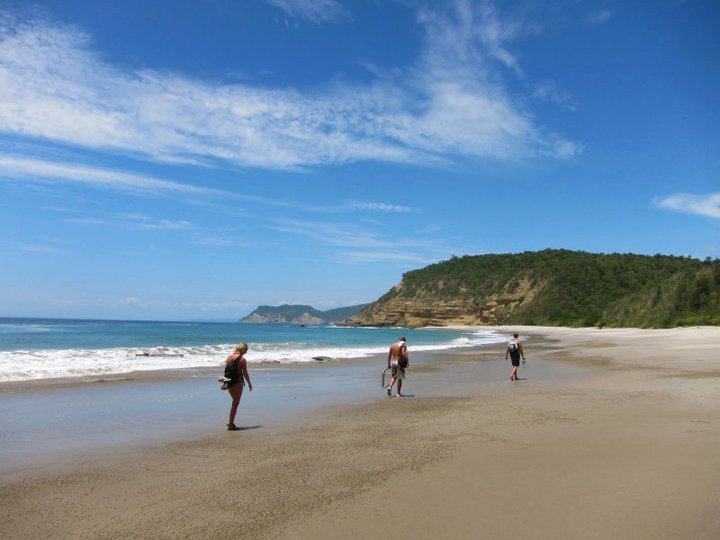
Beautiful Playita, closed to the public
Another perk of the research permit manifested itself at another experimental site, located in Machalilla National Park. Entrance into this area is something like $15 for foreigners, but with a wave of our permit, in we go for free! And what a beach it is!
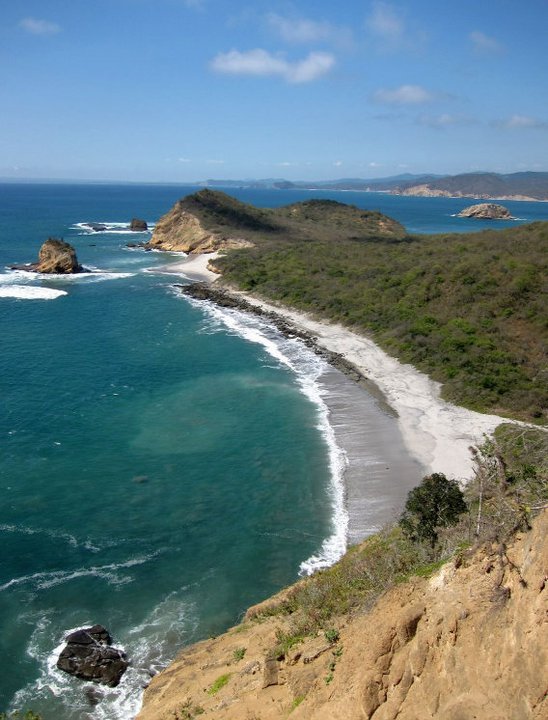
Machalilla National Park, where one of the study sites is located
A beautiful life lends itself to beautiful photos. Enjoy.
March low tides photo album
https://www.facebook.com/album.php?aid=2351045&id=19700757&l=cb4dc98eaf
Posted by Whitney 04/08/2011


 goodells.net

 Web Design by Goodell
©1995-2026

